More than 550 low-magnitude earthquakes have been detected beneath Mount Teide in the latest burst of seismic activity on Tenerife, but scientists have stressed there is no increased risk of a volcanic eruption in the short or medium term.
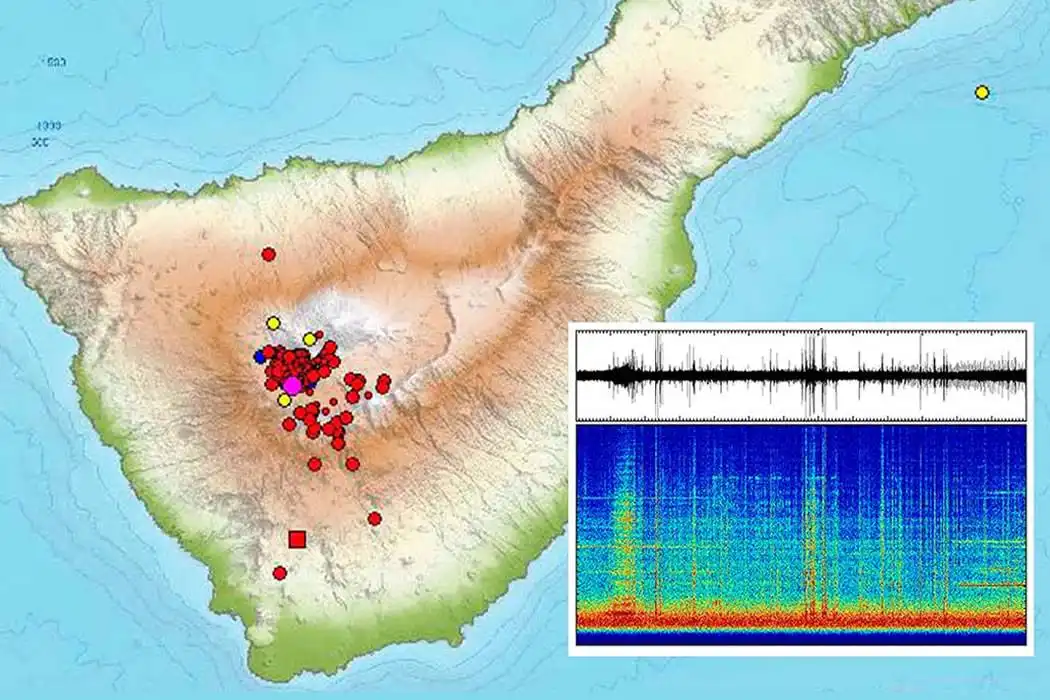
According to the National Geographic Institute (IGN), the activity took place last night and was concentrated beneath the western side of Las Cañadas del Teide, affecting the municipalities of Guía de Isora, Vilaflor, and Santiago del Teide.
None of the tremors were felt by residents or visitors.
A continuous signal followed by hundreds of micro-earthquakes
The IGN said the activity began at 6:58pm yesterday (Tuesday 22nd July) when monitoring stations in central Tenerife detected a continuous low-frequency seismic signal lasting for almost an hour.
As the signal weakened, it was followed by several further low-frequency pulses throughout the night. From around 10:00pm, a swarm of repetitive, low-magnitude earthquakes began.
Scientists have manually confirmed 95 earthquakes, while the institute's automatic monitoring systems recorded more than 550 seismic events during the night.
This is the tenth seismic swarm recorded in Tenerife so far this year, following similar episodes in February, March and June.
Activity linked to underground fluid movement
Most of the earthquakes originated at depths of 10 to 15 kilometres below sea level.
Experts identified a mixture of volcano-tectonic, hybrid and low-frequency (LP) earthquakes, all belonging to the same seismic family.
In its technical report, the IGN explained that the recorded signals are consistent with the movement of fluids deep beneath the island. However, it stressed that this type of activity does not indicate that the volcanic process is accelerating.
The institute also reiterated that the latest swarm does not increase the likelihood of an eruption in Tenerife in the short or medium term.
Volcanologist urges calm
IGN's director for the Canary Islands, Itahiza Domínguez, also sought to reassure the public, describing the earthquakes as "small, low-magnitude events that have not been felt by the population."
Speaking to Televisión Canaria, the volcanologist explained that authorities would only consider raising the volcanic alert level if additional warning signs appeared, such as significant ground deformation or earthquakes above magnitude 2 on the Richter scale. Neither of those indicators has been detected at this stage.
Constant monitoring continues
The IGN continues to monitor volcanic and seismic activity across the Canary Islands in real time through a network of more than 100 monitoring stations and sampling points across Tenerife.
The organisation is in direct communication with Civil Protection authorities and says all data remains provisional while specialists complete a detailed analysis of the recorded signals.
Officials have again emphasised that the current activity is being closely monitored but there is no cause for alarm.