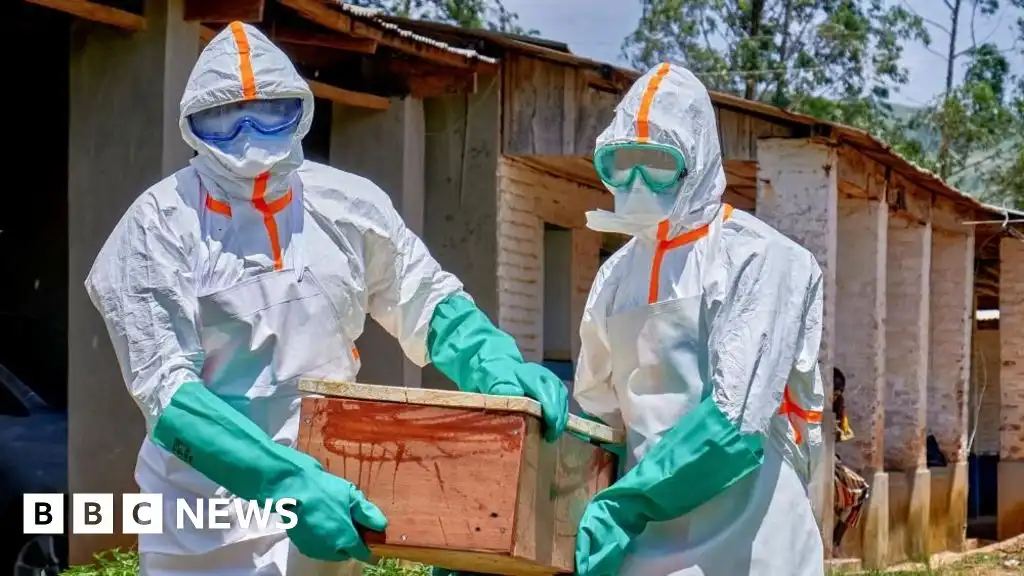
Police in the east of the Democratic Republic of Congo fired shots in the air after angry crowds attempted to reclaim the bodies of loved ones who had died at an Ebola treatment centre in Mongwalu, two local journalists told the BBC.
Sunday's unrest continued throughout the day, the reporters said.
The treatment centre, in a hospital compound, was the same place that was targeted overnight on Friday into Saturday, when an isolation tent was set ablaze.
The body of a dead Ebola victim is highly infectious and can lead to the virus spreading further when prepared for burial.
There have been more than 900 suspected Ebola cases in the current outbreak and 220 suspected deaths, officials say.
According to Mongwalu General Hospital's medical director Dr Richard Lokudu, Sunday's attackers demanded the bodies of two people be given to their families.
He told the Associated Press news agency that the hospital was on "general alert".
Suspicion of the authorities and scepticism about the cause of death has led to deep distrust among some in the communities currently affected by Ebola.
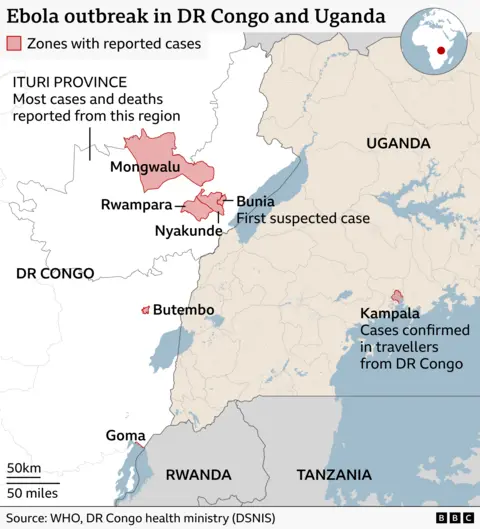
On Thursday, crowds set fire to isolation tents in hospital in Rwampara - a town 85km south-east of Mongwalu where cases are also concentrated - after they were prevented from taking the body of a man thought to have died from Ebola, away for burial.
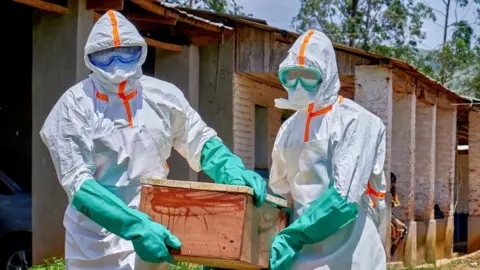
Red Cross volunteers are carrying out safe burials under police protection to stop the virus spreading.
Three volunteers have also died from suspected Ebola likely caught while managing dead bodies, according to the organisation.
This comes as heath ministers from DR Congo and neighbouring Uganda and South Sudan over the weekend finalised their cross-border co-ordination in response to the outbreak, alongside the head of the Africa Centres for Disease Control and Prevention (Africa CDC).
On Monday, Uganda confirmed two new cases, both health workers, bringing its total infections to seven. The patients are receiving treatment and people they have been in contact with are being traced, the health ministry said.
Africa CDC warned that other countries on the continent - namely Angola, Burundi, the Central African Republic, Ethiopia, Kenya, Rwanda, South Sudan, Tanzania and Zambia - are at risk from an outbreak.
The agency's director-general Dr Jean Kaseya said he is holding a meeting on Monday for "all African leaders" to share guidance.
Speaking to BBC World Service's Newsday, he said their plan looks at how to avoid waste, how to isolate and manage cases, and how to ensure people have "dignified funerals".
Kaseya also said DR Congo, Uganda and South Sudan, agreed on a $319m (£236m) budget to stop the outbreak from spreading.
On where the money will come from, Kaseya said, so far, 10% had been secured by the affected countries.
On Monday, South Africa's President Cyril Ramaphosa pledged $5m as an act of solidarity.
Kaseya said that African businessmen would be meeting in Lagos on 29 May to "raise additional funds", while international partners such as the US, UK, European Union and World Bank are also "committing funds".
Africa CDC declared an Ebola outbreak in DR Congo's Ituri province on 15 May. It is the country's 17th Ebola outbreak.
Days later, the World Health Organization (WHO) declared it a public health emergency of international concern.
The outbreak is caused by the rare Bundibugyo species of Ebola, which had not been seen for over a decade.
There are currently no vaccines or medications that target Bundibugyo, which makes it harder to treat.
Last week, the WHO said it could take up to nine months for a vaccine to be ready.
Along with Ituri, cases have been detected in DR Congo's North and South Kivu provinces, which border Rwanda.
Parts of the two eastern areas are under the control of rebel group M23, whose clashes with government forces have brought additional difficulties in dealing with the virus.
Go to BBCAfrica.com for more news from the African continent.
Follow us on Twitter @BBCAfrica, on Facebook at BBC Africa or on Instagram at bbcafrica