Lanzarote's famous wine industry has received a major boost, with the island's 2026 grape harvest expected to finish at more than three million kilos – a remarkable recovery following two years of significantly lower production.
The latest forecast comes from the Regulatory Council of the Lanzarote Designation of Origin (DOP), which says this year's harvest is entering its final stages with considerable optimism.
It is a significant improvement on initial expectations.
When harvesting began unusually early in July because of high temperatures, the Regulatory Council estimated that the final crop could be around 2.5 million kilos.
By 11th August, more than two million kilos had already been collected and expectations were revised upwards towards three million. Later that month, the total had reached 2.656 million kilos, with producers predicting a final figure of between 2.7 and 2.8 million.
Now the outlook is even better.
The Regulatory Council says the final harvest could exceed three million kilos of grapes, putting 2026 firmly among Lanzarote's stronger recent harvests.
Huge improvement on last year
The scale of the recovery becomes particularly clear when compared with 2025. Last year's harvest produced just 843,000 kilos of grapes, making it one of the smallest harvests recorded on the island in recent years. By comparison, Lanzarote produced approximately 3.3 million kilos in 2023. Exceeding three million kilos this year would therefore mean producing more than three-and-a-half times the amount harvested in 2025.
But it isn't simply the quantity of grapes that is giving Lanzarote's wine producers reason to celebrate.
The Regulatory Council says the grapes arriving at the island's wineries are in excellent condition, with the quality of the 2026 crop providing encouraging prospects for the wines that will eventually be produced from this year's harvest.
Lanzarote's unique volcanic wines
Wine production is one of the most distinctive parts of Lanzarote's landscape, culture and tourism industry.
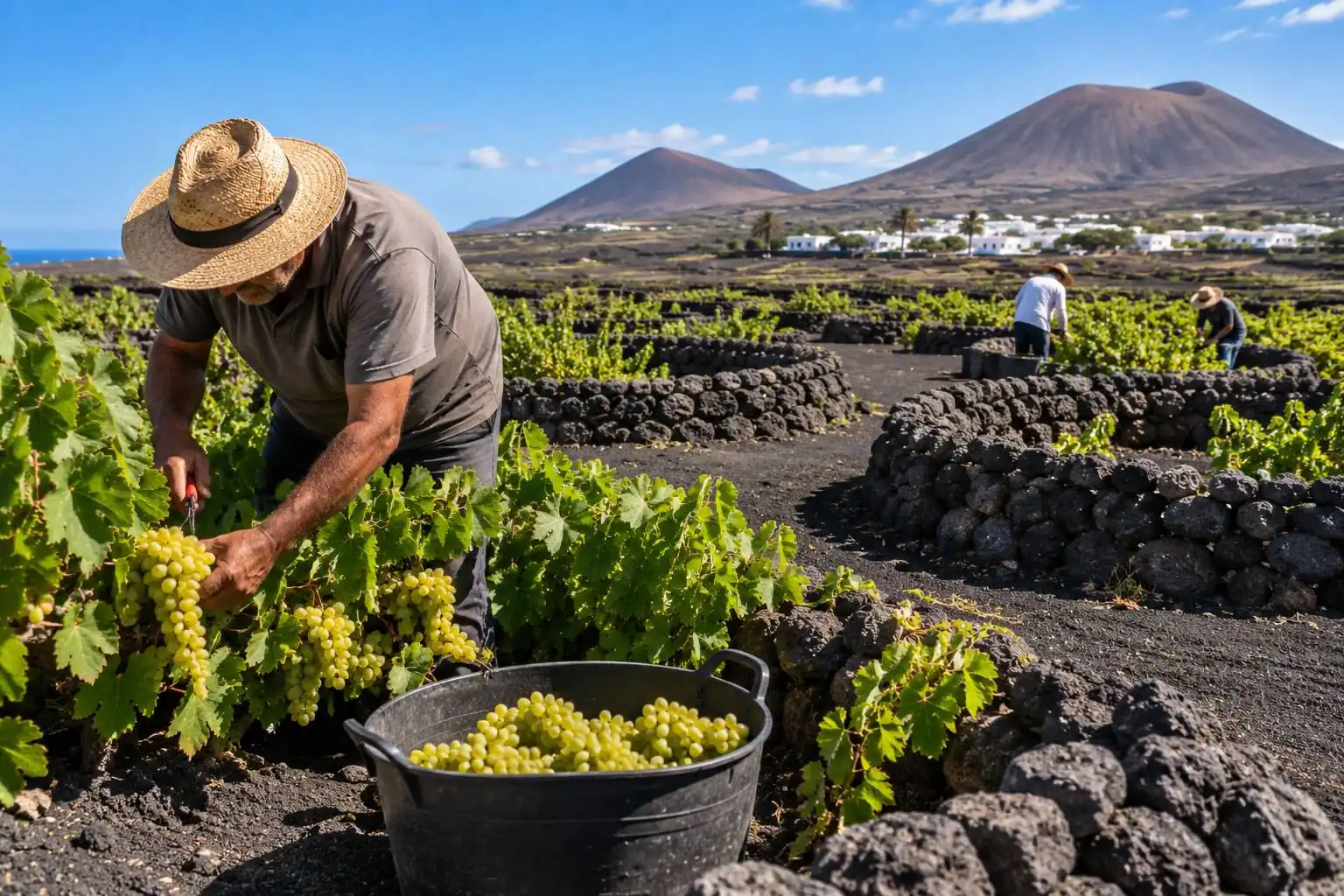
Nowhere is that more evident than La Geria, where vines grow in pits dug into the island's volcanic lapilli, locally known as rofe, often protected from the wind by characteristic semi-circular stone walls.
The cultivation method creates one of the Canary Islands' most recognisable landscapes and allows vines to survive in Lanzarote's exceptionally dry conditions.
The island's signature grape is Malvasía Volcánica, which accounts for approximately 80% of Lanzarote's varieties. By mid-August, the vast majority of this year's Malvasía Volcánica crop had already been harvested, while varieties including Listán Negro, Moscatel and Diego followed later in the season.
For visitors, the wine industry has also become an important part of Lanzarote's tourism offer, with wineries, vineyard tours, tastings and events attracting people into the island's traditional wine-growing areas.
A welcome turnaround for growers
The recovery will be particularly welcome for the island's viticulturists and wineries following the exceptionally small 2025 crop.
There has been more good news for growers this year too.
Towards the end of August, the president of the Regulatory Council, Jorge Rodríguez, said conventional grapes were achieving prices around €3.80 to €4 per kilo, while organically grown grapes were reaching approximately €4.50 to €5 per kilo, which he described as record-level pricing compared with previous harvests.
Attention will now turn from the vineyards to the wineries as producers begin transforming the 2026 crop into the island's next vintage – and gives Lanzarote's winemakers plenty of reasons to raise a glass.