There are two regions in the very centre of Italy that travellers often hear about in whispers. Umbria, the green heart of the country, all rolling hills, hilltop towns, and ancient monasteries. Le Marche, its quieter neighbour to the east, where the Apennines fall gently toward the Adriatic and medieval villages still feel like a private discovery.
Side by side, they form one of the most rewarding journeys in Italy, and the only way to truly know them is from behind the wheel, with no fixed plan and a country road unfolding ahead.
Umbria and Le Marche share a quality that has all but vanished from Italy's more famous destinations: they are still themselves. The villages have not been polished for tourists. The trattorie still cook for locals. The farmers in the fields still wave as you pass. Together, these two regions offer the deep Italy that travellers dream of, an Italy of stone and silence, of olive groves and church bells, of long lunches under wisteria.
The landscape changes gently as you drive between them. Umbria's wooded hills, dotted with abbeys and vineyards, give way to the rugged Sibillini mountains, then descend through valleys of sunflowers and wheat toward Le Marche's golden coast. Distances are short. The roads are quiet. Every curve seems to reveal another bell tower in the distance, another castle on a ridge, another reason to slow down.
Umbria is a region of pilgrims and painters, of saints and silence. Assisi clings to its pink-stone hillside, its basilica still drawing visitors from around the world, yet at dawn the streets are empty and the views over the valley feel like a gift. Spello bursts into flower each spring; Spoleto guards its Roman aqueduct and medieval rocca; Orvieto rises dramatically from a cliff of volcanic tuff, its cathedral facade glittering in the sun.
Beyond the famous names, the real Umbria reveals itself in lesser-known corners: the Valnerina with its waterfalls and stone hamlets, the wine country around Montefalco where Sagrantino grapes produce some of Italy's most powerful reds, the truffle forests of Norcia, the lavender fields of Castelluccio. The food is hearty and honest, strangozzi pasta with black truffle, wild boar ragù, lentils, pecorino, and bread without salt that tells of an older agricultural rhythm.
Cross the Apennines and you enter Le Marche, perhaps the most underrated region in all of Italy. Here the hill towns feel sculpted by time. Urbino, birthplace of Raphael, still holds its Renaissance ducal palace as if the court had only just left. Ascoli Piceno gathers around one of the most beautiful travertine piazzas in Europe, where locals sip anisetta at dusk. Macerata, Recanati, Loreto, each town has its own quiet pride, its own story.
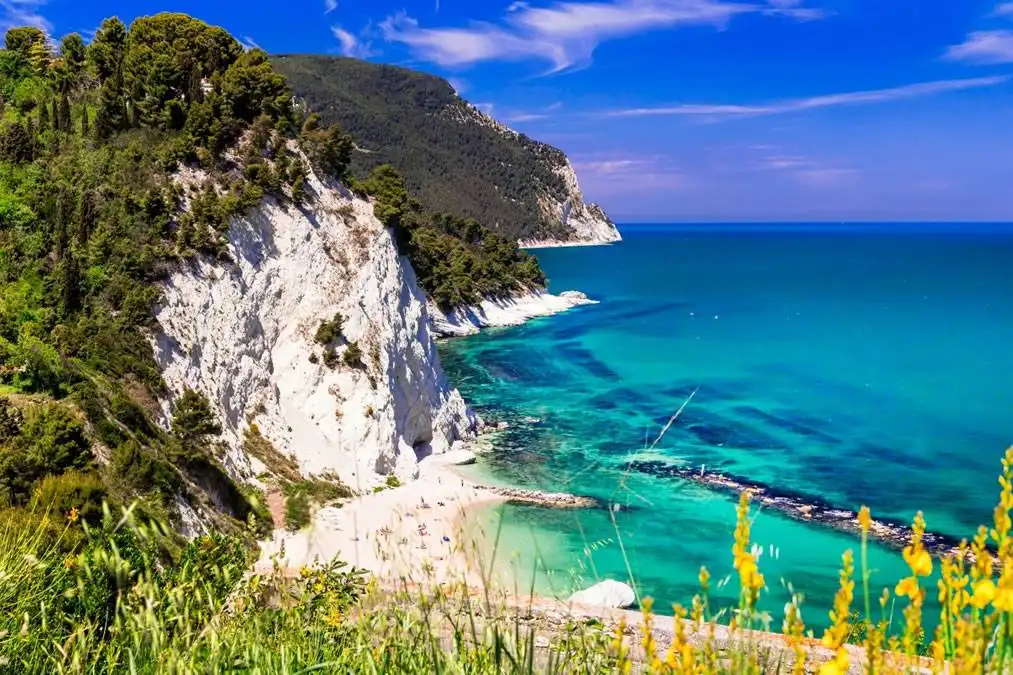
The coast is a surprise. Long sandy beaches stretch along the Adriatic, and the Conero Riviera offers turquoise coves backed by white cliffs and pine forests. Inland, the Frasassi caves hide vast cathedrals of stone beneath the hills, and the Sibillini mountains offer wildflower meadows in spring and dramatic walks in summer. The food follows the geography, brodetto fish stew on the coast, vincisgrassi lasagna in the hills, olives stuffed and fried in Ascoli, Verdicchio wine that ages beautifully and pairs with everything.
Public transport reaches the main towns, but the real magic of these regions lives in the spaces between them. The country agriturismo down a dirt road. The roadside stand selling jars of honey and saffron. The viewpoint nobody told you about. The trattoria with no sign that locals describe as "the best around." A car turns these regions from a series of destinations into one continuous discovery.
Roads are well kept, traffic is light, and the temptation to detour is part of the pleasure. You set the pace, change your mind, stay an extra night when a place wins you over.
A self-drive holiday in Umbria and Le Marche is best when the logistics fade into the background and the journey takes over. Italy Trails designs tailor-made self-drive itineraries through central Italy, pairing the right rental car with carefully chosen agriturismi, country estates, and small boutique hotels. Their suggested routes connect the well-known highlights with the quieter places that make these regions so memorable, leaving you free to wander, linger, and follow your own curiosity.
Umbria and Le Marche reward travellers who arrive without urgency. Two regions, one open road, and a side of Italy that still feels like a secret.
Take the long way. It is worth it.