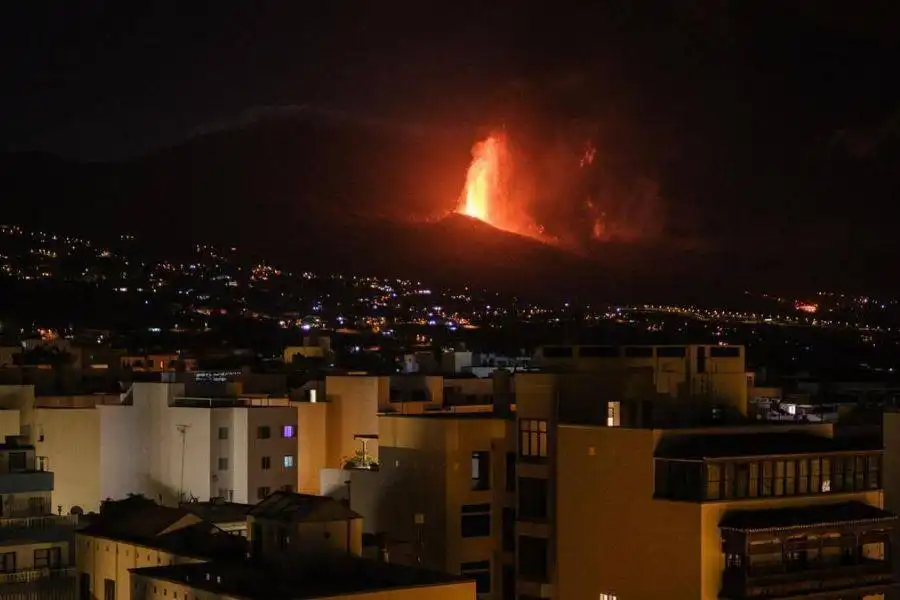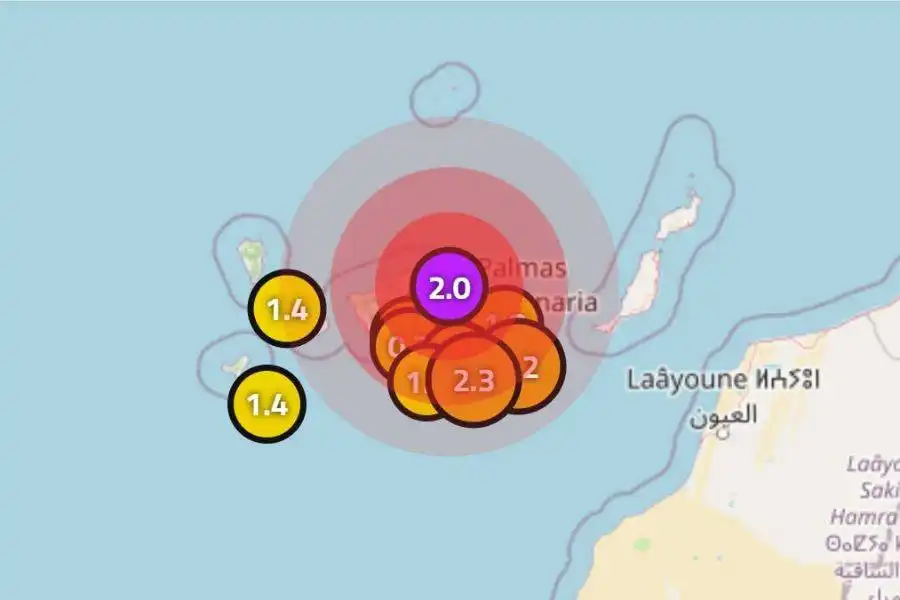
A total of 46 earthquakes have been recorded in and around the Canary Islands during a recent 48-hour period, with seismic activity detected beneath or close to Tenerife, Gran Canaria, La Palma and El Hierro, as well as in several areas of the Atlantic surrounding the islands.
Despite the headline figure, the earthquakes have overwhelmingly been very small in magnitude, and there is currently no indication that the activity represents anything unusual or dangerous.
According to data from the National Geographic Institute (IGN), the strongest earthquake highlighted during the period reached just 2.3 magnitude, while many of the movements measured between approximately 0.7 and 2.0 on the Richter scale.
The IGN's latest catalogue confirms a succession of small earthquakes across different parts of the archipelago. Recent events include seismic activity near San Miguel de Abona in Tenerife, Agaete and Gáldar in Gran Canaria, Frontera in El Hierro and Tazacorte and Villa de Mazo in La Palma.
Several other earthquakes have been recorded offshore in areas classified by the IGN as Atlántico-Canarias.
Earthquakes recorded across several islands
One of the most notable events occurred northwest of Gáldar in Gran Canaria, where a magnitude 2.2 earthquake was registered at a depth of approximately 20 kilometres.
Another was detected northeast of Agaete, measuring magnitude 1.3. Although considerably smaller, its hypocentre was only around four kilometres deep.
In Tenerife, a magnitude 1.6 earthquake was recorded southeast of San Miguel de Abona, at a depth of around 25 kilometres, while another small movement measuring magnitude 0.7 was detected northeast of Guía de Isora.
A magnitude 1.4 event was recorded west of Frontera in El Hierro, while La Palma has also continued to register small earthquakes, including events near Tazacorte and Villa de Mazo.
Offshore activity has also been detected, including earthquakes of magnitude 2.3, 2.0, 1.8 and 1.6 in areas of the Atlantic around the islands.
Does this mean a volcanic eruption is becoming more likely?
Importantly, there is currently no evidence that these earthquakes mean a volcanic eruption is imminent or becoming more likely.
Small earthquakes are regularly detected throughout the Canary Islands because of the volcanic and tectonic nature of the archipelago.
The IGN operates an extensive seismic monitoring network capable of detecting movements far too small to be noticed by people. This means that earthquakes measuring considerably below magnitude 2 can now routinely appear in the official catalogue.
For context, the Canary Islands recorded 1,608 earthquakes during 2024, with the greatest concentrations around Tenerife and in the marine area separating Tenerife and Gran Canaria. Only 18 of those earthquakes were reported as being felt by the population.
The recent activity also does not represent one single earthquake swarm occurring beneath all of the islands. The events are geographically dispersed and can have different origins.
Some seismicity around Tenerife is associated with the island's volcanic and hydrothermal systems, while earthquakes in the sea between Tenerife and Gran Canaria can be associated with regional tectonic stresses.
Perhaps the most important message for residents and holidaymakers is that no seismic or volcanic emergency has been declared as a result of the latest activity.