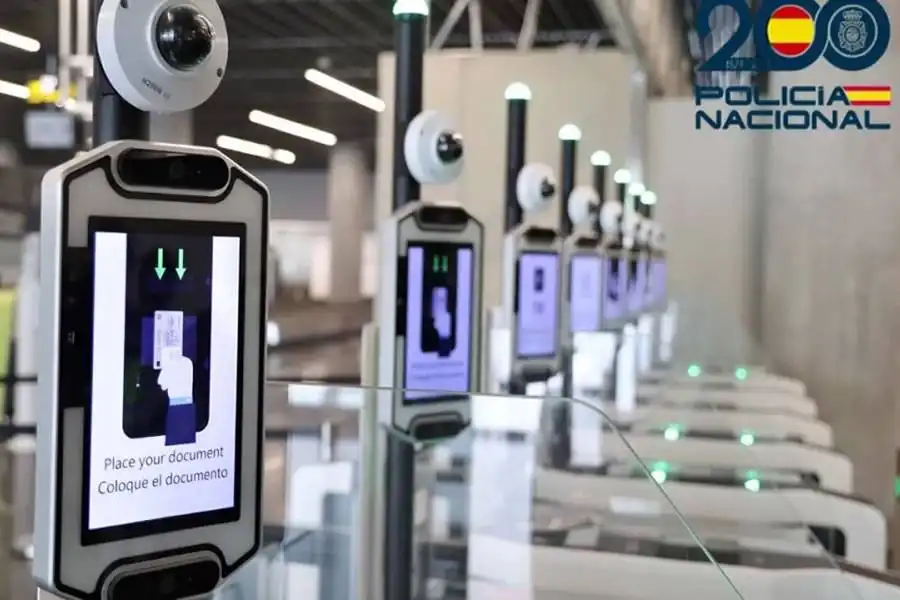
The Partido Popular (PP) in the Canary Islands has announced it will take a proposal to the regional parliament calling on the Spanish Government to suspend the EU’s Entry/Exit System (EES) at airports across the archipelago.
The move comes amid ongoing disruption at passport control, which the party claims has led to long queues and congestion in recent months, particularly affecting British tourists, the islands’ largest visitor market.
Concerns over airport delays
David Morales, the PP’s tourism spokesperson in the Canary Islands Parliament, has questioned the implementation of the system, which was due to be fully operational from 10th April.
He argues that the rollout has fallen short of expectations and is impacting airport operations. The criticism centres on repeated scenes of overcrowding at border control points, where passengers have reportedly faced extended waiting times.
According to Morales, both tourism business organisations and police representatives had previously warned about the risk of saturation if the system was introduced without adequate preparation.
He also highlighted the reputational damage caused by images circulating abroad showing long queues at airports such as Tenerife South, suggesting this could harm the islands’ image as a smooth and welcoming destination.
Appeal to EU regulation
To support its position, the PP is citing EU Regulation 2025/1534, which allows Member States to temporarily suspend the EES at specific border crossings in cases of technical failures or where excessive traffic leads to significant delays.
Morales maintains that the situation at airports including Gran Canaria, Lanzarote and Fuerteventura fits within those criteria and that a temporary suspension would allow deficiencies in the system to be addressed.
The party insists the measure would be provisional while technical and operational shortcomings are resolved.
Staffing and infrastructure concerns
The PP has also pointed to what it describes as insufficient technological resources and a lack of adequately equipped biometric data capture systems, along with a shortage of National Police officers at airport border controls.
In addition, Morales has called on AENA to ensure that airport facilities are properly adapted to manage passenger flows, particularly during peak travel periods on routes to and from the UK.
Comparison with Greece
The debate follows the recent decision by Greece to temporarily suspend biometric checks for British tourists until the system is fully operational.
Morales cited the Greek example as a demonstration of alternative management approaches, arguing that similar measures should be considered in the Canary Islands to prevent further disruption.
The proposal will now be debated in the regional parliament, where the PP is seeking formal backing to press Madrid for action.