Residents of one of Gran Canaria’s most remote communities are fighting to preserve an unusual tradition that has been bringing generations together for almost 70 years: the Baile de la Papa, or ‘Potato Dance’.
The tiny community of El Hoyo, in the municipality of La Aldea de San Nicolás, is working to ensure that its much-loved Baile de la Papa does not disappear as the generation who remembers its beginnings grow older.
The unusual dance has been part of the local San Pedro festivities since 1959 and is considered an important piece of the area’s intangible cultural heritage.
Now, the Rosa Nueva Residents’ Association has carried out the first systematic study of the tradition, with funding from the Cabildo de Gran Canaria, recording the memories of some of the last surviving residents who witnessed or took part in its earliest editions.
So, what exactly is the Potato Dance?
Despite its name, the Baile de la Papa has nothing to do with the potato harvest, religion or the island’s indigenous Canarian heritage.
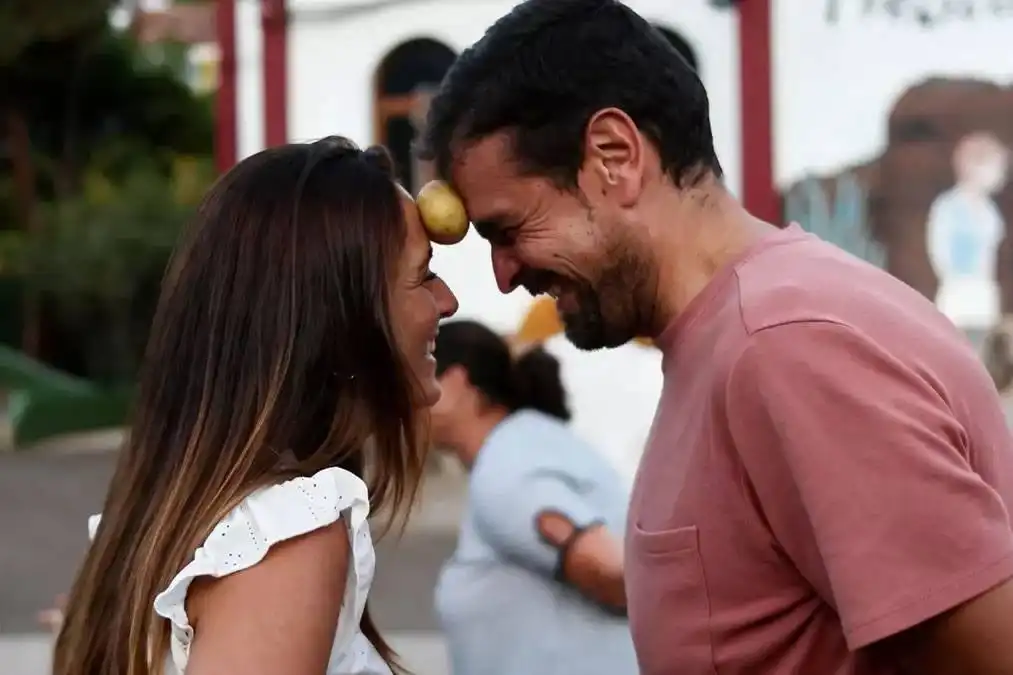
Instead, it is essentially a dancing competition with one very important rule: don’t drop the potato!
Couples dance together while holding a potato between their foreheads. Their hands must remain away from it and, as the music gets faster, the competition becomes progressively more difficult.
Contestants have traditionally been made to dance with their hands behind their backs or above their heads, and even while standing or hopping on one leg.
If the potato slips towards the eye, is supported by the nose or falls completely, the couple can be eliminated.
Gabriel Ramírez knows the technique better than most. He has won the competition four times alongside his wife, Margarita González. Margarita, now 85, says the secret is to move your waist while keeping your head as still as possible.
She is particularly pleased that younger generations continue to take part, something residents believe will be essential if the tradition is to survive.
From a garage to a village tradition
The origins of the Baile de la Papa in El Hoyo date back to 1959, when Jorge Ojeda Montesdeoca introduced the game after apparently seeing similar dances elsewhere.
Researchers believe it may have been influenced by the ‘Potato Dance’ seen in the 1950 Hollywood musical Duchess of Idaho, starring Esther Williams and Van Johnson, which features couples competing while holding a potato between their foreheads.
Local resident Teresa Cárdenes, known as Teresita, remembers how it all began. She arrived in El Hoyo from Tejeda in 1959 at the age of 16 and recalls Jorge collecting a bucket of similarly sized potatoes after the local harvest.
The first dances took place in the garage of her home, where tomato crates were used as seats. According to Teresita, mothers would sit on the crates keeping a close eye on their daughters to make sure they didn't get too close to their dance partners.
Not everyone approved of the new entertainment, however. She recalls some older residents jokingly accusing Jorge of inventing the competition simply as an excuse to get closer to the women.
When the village had a fiesta before it had a saint
The memories being collected also tell the wider story of life in this isolated part of Gran Canaria.
Nicolasa ‘Nico’ Ojeda, now 76, was one of three young girls who went from house to house collecting money so the community could buy its statue of San Pedro.
She remembers people walking to the celebrations from communities including Tasarte and Tasartico, arriving in the morning for the festivities.
Families would eat together in the shade before taking part in traditional dances and eventually making the journey home.
The Potato Dance became an important part of those celebrations.
Anyone could enter, although choosing the right partner mattered. Couples of similar height who were accustomed to dancing together often had an advantage when trying to keep the potato securely between their foreheads.
A jury made up of residents and people from neighbouring areas decided who remained in the competition, with the eventual winners receiving a trophy.
Race against time to record its history
The Rosa Nueva Residents’ Association is now trying to document as much of the tradition as possible before first-hand memories are lost.
Association president Begoña Saavedra said the organisation realised there was surprisingly little written information about something that had played such an important role in the community for decades.
The association itself was established 48 years ago, and has recently been revitalised as a meeting place where residents can take part in activities and share their memories of life in El Hoyo.
Coffee mornings, children's activities and sewing classes have helped bring people together, but they have also revealed just how much local history remains stored primarily in people's memories.
Again and again, conversations returned to the Baile de la Papa. That prompted the association to seek funding for a formal heritage investigation into exactly how and why the dance began in El Hoyo.
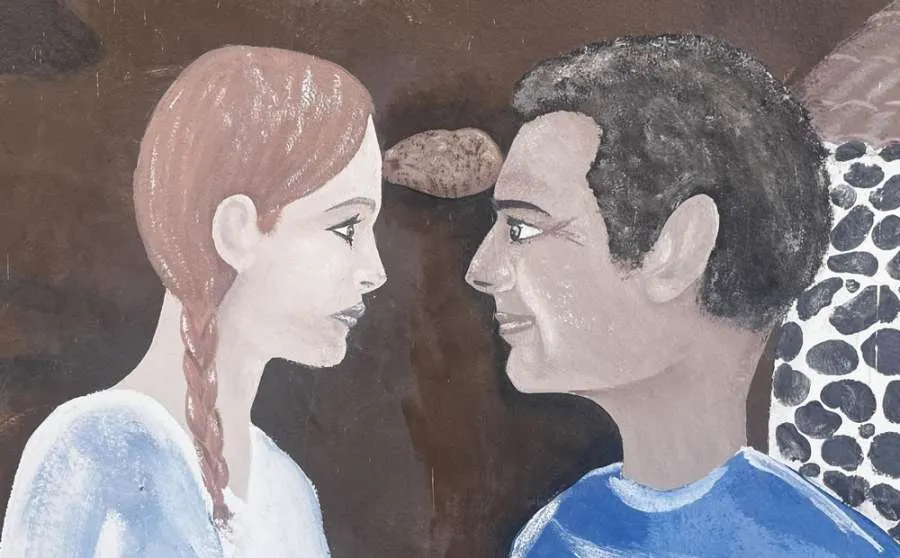
Could the Potato Dance become protected heritage?
Following completion of the study, an application has been made for the Baile de la Papa to be recognised as an intangible Asset of Cultural Interest (Bien de Interés Cultural) at either island or regional level.
The association is also taking the story of the dance into schools and cultural centres to introduce it to younger generations.
For those involved, preserving the tradition does not mean claiming that it has ancient or indigenous origins.
Its significance instead comes from the fact that a small and geographically isolated community has maintained the same distinctive tradition annually since 1959, with the exception of the pandemic year.
Association members are particularly keen that future generations understand how the original competition was performed and don't allow its rules and character to become lost over time.
More than just a dance
The revival of the residents’ association has also had a wider impact on El Hoyo.
For some older residents, it has provided a new social space after decades spent working in agriculture, tomato packing facilities, raising families or travelling to work in the tourist areas of southern Gran Canaria.
Residents now meet to sew, drink coffee, exchange photographs and talk about the community's past.
For 70-year-old Ana María Díaz Suárez, the experience has been nothing short of “a rebirth”.
And that sense of community may ultimately be what keeps the Baile de la Papa alive.
Almost seven decades after a bucket of potatoes was taken into a village garage and couples first tried balancing them between their foreheads, the people of El Hoyo are determined that one of Gran Canaria's most unusual local traditions will continue for generations to come.