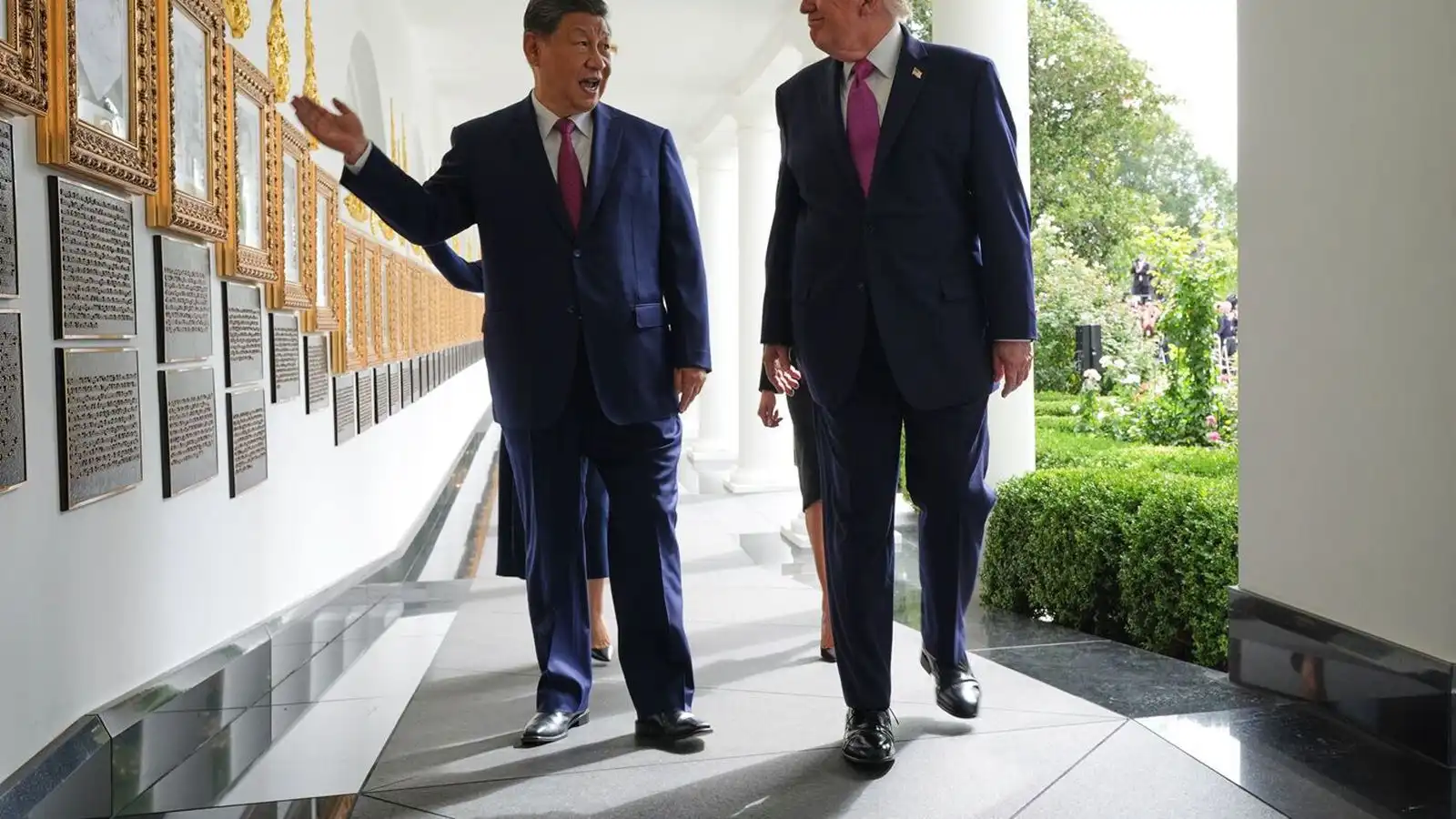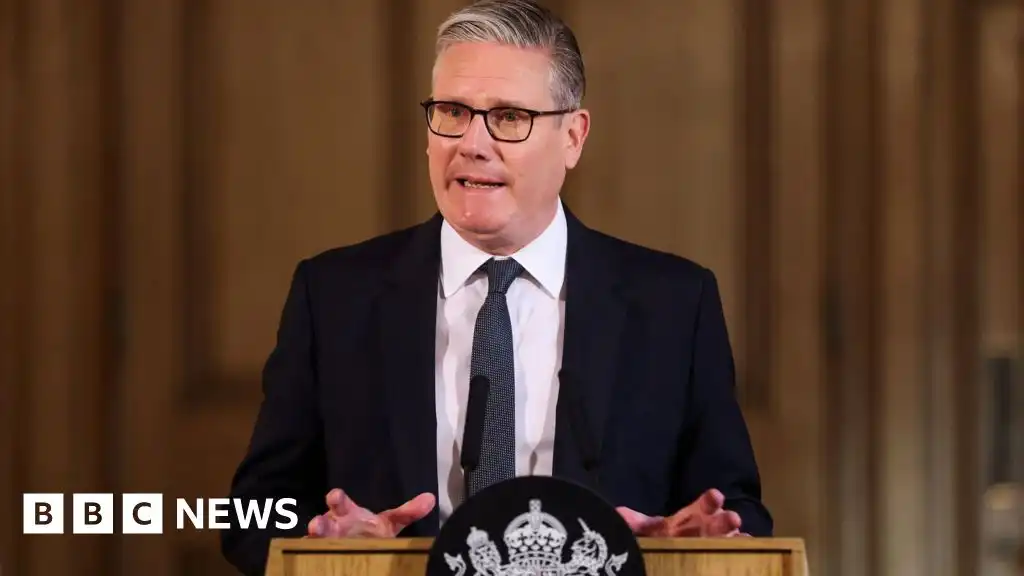
Prime Minister Sir Keir Starmer has said "every part of society" has a responsibility to tackle antisemitism in the UK at a summit in Downing Street.
Sir Keir told senior figures from the police, the arts, higher education and businesses they will be expected to confront "the forces that drive this hatred", describing a recent spate of attacks against British Jews as "a crisis".
The government has announced an extra £1.5m in funding to strengthen community cohesion and protect Jews in areas of greatest risk. Hate crime prosecutions will be fast-tracked.
It comes after the stabbing of two Jewish men in Golders Green and a string of attacks at synagogues and other Jewish sites in recent months.
The prime minister has faced criticism from many in the Jewish community following the Golders Green attack that the government has not done enough to keep them safe and was heckled when he visited the north London suburb on Thursday.
Sir Keir said the recent attacks against British Jews were "a crisis for all of us".
He added: "So, it is not enough to simply say we stand with Jewish communities. Of course we do, but we have to show with action. And that responsibility lies with each and every one of us."
Tuesday's summit saw discussions with members of the Jewish community, hosted by senior ministers, with leaders in their sector, reflecting on identifying the forms of antisemitism on display and what can be done to tackle it.
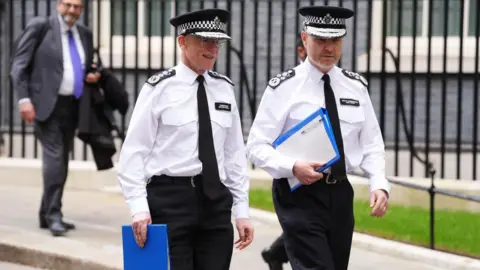
More than 90 people attended the meeting including Metropolitan Police Commissioner Sir Mark Rowley, Chief Constable Sir Stephen Watson from Greater Manchester Police, as well as university vice-chancellors, Arts Council England, NHS bosses and trade union leaders.
At the summit, the prime minister announced that universities will be expected to publish the scale of antisemitism on their campuses and "demonstrate action" they are taking to tackle it.
Asked what consequences universities could face if they do not take appropriate action, a Downing Street spokesperson said "we will set out next steps in due course", adding: "We will absolutely hold them to account."
Meanwhile, he said the Arts Council, which supports cultural organisations and projects, would be expected to withdraw public funding where it is being used to platform antisemitism.
Leaving the summit, president of the Board of Deputies of British Jews, Phil Rosenberg, said there was "anger" that issues with antisemitism had been allowed to "fester" and become a "crisis" but that the summit had been helpful.
"We need to do three things: we need to protect, we need to prosecute and we need to partner," he said.
The Metropolitan Police declared a terrorist incident following the stabbing of Shloime Rand, 34, and Moshe Shine (referred to in court as Norman Shine), 76, in Golders Green last Wednesday.
Essa Suleiman, 45, has been charged with three counts of attempted murder in relation to the attack on 29 April, including a third man - Ishmail Hussein, who knew Suleiman - who was attacked earlier the same day.
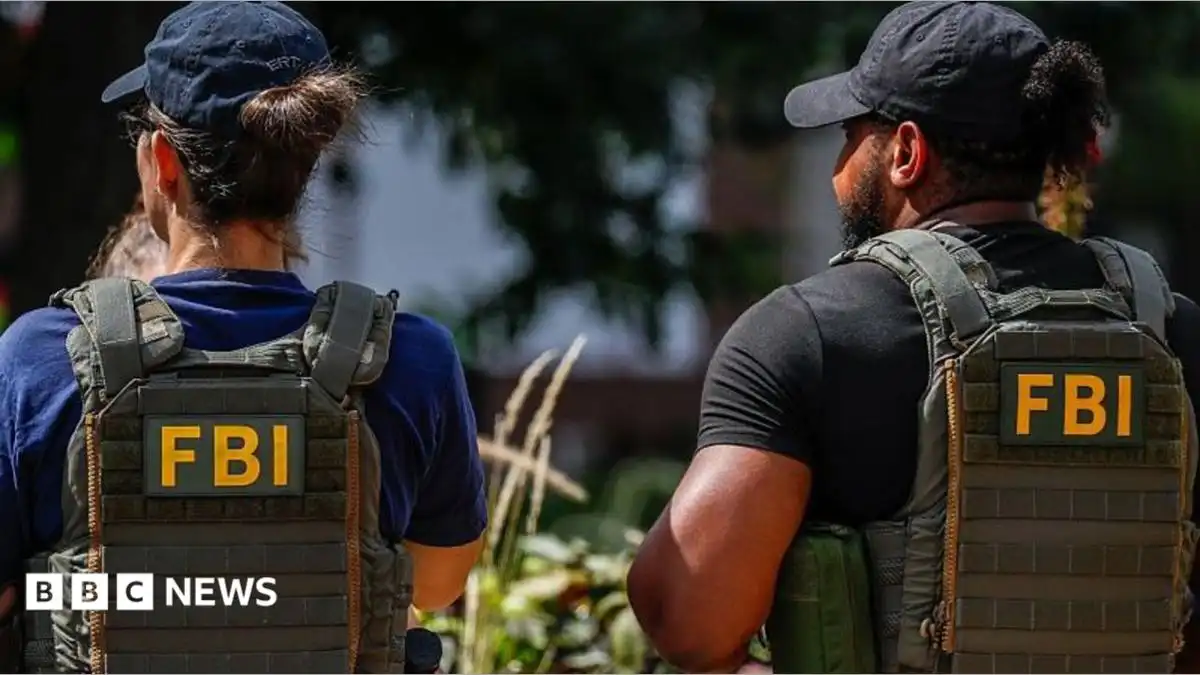
Counter-terrorism officers are also investigating a suspected arson attack at a former synagogue in Whitechapel, east London, which took place in the early hours of Tuesday morning.
It follows a number of other suspected arson attacks, including on ambulances owned by a Jewish charity and a synagogue in north London.
At the summit, Sir Keir said one of the lines of inquiry was "whether a foreign state has been behind some of these incidents".
"Our message to Iran, or to any other country that might seek to foment violence, hatred or division in society, is that it will not be tolerated," Sir Keir said.
He added that the government was "fast-tracking legislation to tackle these malign threats".
Many in the Jewish community have expressed frustration in recent days with what they see as a lack of government action on hate speech, and have renewed calls for Iran's Islamic Revolutionary Guard Corps (IRGC) to be proscribed.
The group, which was set up to defend Iran's Islamic system, has been accused by Western nations of sponsoring terrorism abroad.
Ministers are now planning new anti-terror powers that would enable them to ban state threats such as the IRGC in the next parliamentary session.
Meanwhile, hate crime prosecutions will be fast-tracked due to a "deeply troubling rise in antisemitic incidents", the chief prosecutor for England and Wales has said.
Director of public prosecutions Stephen Parkinson has issued guidance to prosecutors which says "any supporting evidence can be obtained subsequently" once the evidential threshold for a charge is met.
The government has announced an extra £1m will be added to expand the £4m Common Ground programme, led by the Ministry of Communities, Housing and Local Government (MCHLG).
The funding will help local people – especially those from Jewish communities which have been hit hardest recently - take action ranging from community safety work and targeted youth and schools initiatives, to interfaith projects and programmes to challenge antisemitic narratives or hate crime.
An additional £500,000 will also be allocated to Barnet Council, in north London, which Sir Keir said reflected recent serious antisemitic acts in the borough and the large number of Jewish residents there.
It comes on top of an extra £25m for increased police patrols in areas with large Jewish populations, and enhanced security at synagogues, schools and community centres.
Conservative leader Kemi Badenoch said she believed antisemitism levels were "a national emergency", akin to the political climate of the 1930s.
"I am talking about the normalisation of hatred towards Jews," she told BBC Radio 4's Today programme.
She blamed "two particular groups, Islamic extremists but also the particular, nasty strand of hard-left ideology", which she claimed was on display at pro-Palestine marches.
Badenoch labelled the marches "a festival of hatred" that has continued for "far too long".
Sir Keir has suggested there may be a case for banning some pro-Palestinian marches because of the "cumulative" effect on the Jewish community.
However, campaign groups involved in the marches have said it is wrong to connect them with attacks on Jews and argued they have the right to peaceful protest.
Liberal Democrat MP Munira Wilson told the BBC's Politics Live: "Thousands of people go to demonstrate very peacefully but we absolutely should have zero tolerance for the hateful speech we see."
Additional reporting by Judith Moritz and Olivia Ireland.