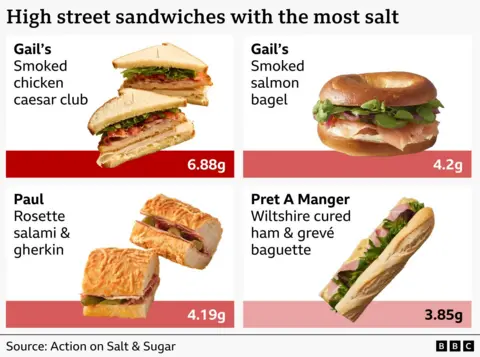
A single sandwich from upmarket bakery Gail's has more salt than nearly five McDonald's cheeseburgers or 10 rashers of bacon, say campaigners.
Their smoked chicken Caesar club contains 6.88g of salt - more than the limit of 6g of salt that adults are recommended to stick to in a day.
Action on Salt & Sugar, which analysed 546 sandwiches, said it was "alarming" how much salt was in them and that people should not be exposed to a "hidden health risk every time they buy lunch".
Gail's has been approached for comment.
Too much salt leads to high blood pressure, which is known as "the silent killer" as it raises the risk of heart attacks and stroke.
Action on Salt & Sugar, based at Queen Mary University of London, found more than one in 10 sandwiches exceeded government salt targets and 44% would have to carry a red warning label on the packet due to their salt content.
It said Gail's smoked chicken Caesar club also had over 1,000 calories and 90% of an adult's daily saturated fat intake.
But while it topped the salt charts, the campaign group said other sandwiches were also "loaded with dangerously high levels of hidden salt".
Other salty sarnies highlighted by the report included a Gail's smoked salmon bagel containing 4.2g of salt, Paul's rosette cheese salami gherkin containing 4.19g of salt, and Pret A Manger's ham & grevé baguette with 3.85g.
Sonia Pombo from Action on Salt & Sugar said people chose sandwiches for their "simplicity, convenience and affordability, but what they're actually eating can be a full day's worth of salt hidden between two slices of bread".
She said it was "frankly unacceptable that some companies continue to sell sandwiches that exceed an adult's daily limit in one go".
The campaign group said high levels of salt were not inevitable, comparing a Pret A Manager chicken sandwich that contained 2.22g of salt with a similar one from Greggs that had only 1.1g. Or a pair of all-day breakfast sandwiches where Sainsbury's kept the salt content to 1.54g while M&S used 2.65g.
An estimated 11.5 billion sandwiches are eaten in the UK every year.
Action on Salt & Sugar urged people to check the salt content on the packet, but said it was down to government to do more.
It said salt was "increasingly being overlooked" as the focus had shifted to tackling obesity and that voluntary targets for manufacturers to reduce salt content in food was a "failure".
Dr Pauline Swift, a consultant nephrologist and chair of Action on Salt & Sugar, added: "Salt reduction is one of the quickest, cheapest and most effective ways to improve public health, yet progress has stalled."
Dell Stanford, a senior dietitian at the British Heart Foundation, said: "This analysis shouldn't put you off from enjoying a shop-bought sandwich occasionally, but there are ways to make your lunchtime staple healthier.
"Check the label and look for a sandwich with less salt and saturated fat, and ideally with lean protein and more fibre."