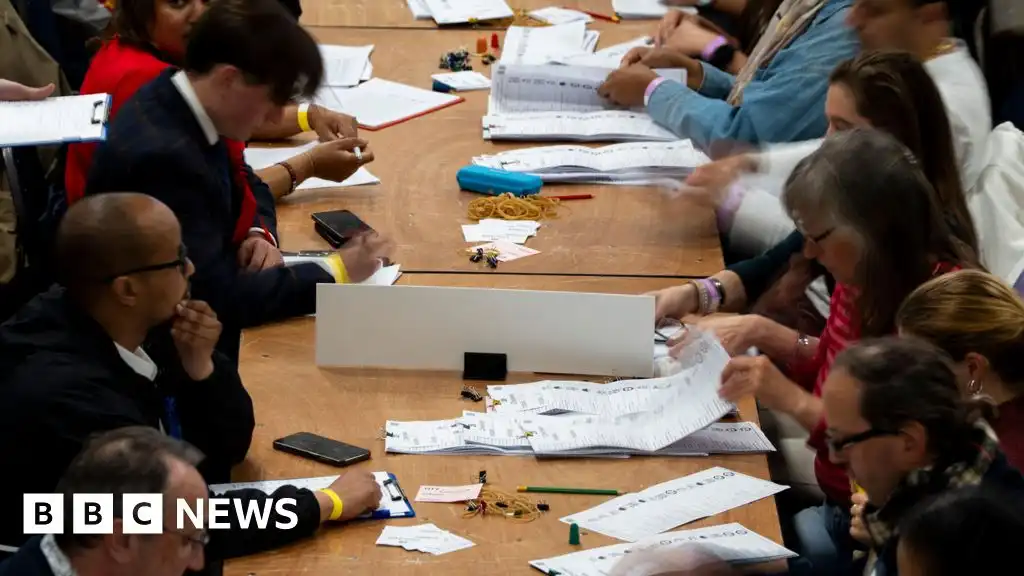
Reform UK has made big gains at the expense of Labour and the Conservatives in English council elections.
Labour has suffered a historic defeat in the Welsh Senedd and the SNP has held onto power for an unprecedented fifth time in the Scottish Parliament.
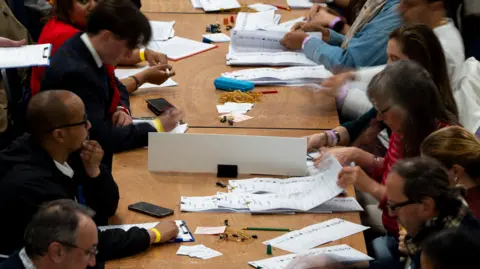
The elections across Scotland, Wales and 136 English local authorities are the biggest set of polls since the 2024 general election, and widely seen as a crucial test of Sir Keir Starmer's premiership.
After the results of the final councils to declare were announced on Saturday, here are the key takeaways.
Reform UK has picked up more than 1,450 council seats, continuing the party's success after its breakthrough in town halls last year.
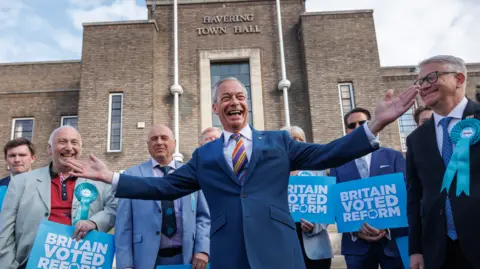
Nigel Farage's party has won big in former Labour heartlands, including in Sunderland and Barnsley, where it took control of the councils after half a century of Labour leadership.
Reform has also made gains at the expense of the Conservatives, seizing control of Newcastle-under-Lyme, Suffolk, and Essex, which hosts the parliamentary seats of half a dozen shadow ministers.
Reform also won control of Havering, which borders Essex, delivering the party its first-ever win in a London borough.
The party was in its infancy the last time these councils were up for election, meaning it was only possible for the party to win majority control in areas where all seats were being contested.
Plaid Cymru has emerged victorious in Wales, winning 43 seats in the Senedd but finishing short of a majority in the newly-expanded 96-seat Senedd.
Reform is in second place with 34 seats, in what marks a breakthrough set of elections for the party in Wales.
And Labour was pushed into third place in the Senedd, with its leader Eluned Morgan, Labour first minister since 2024, losing her seat as well.
The Conservatives have sustained heavy losses too, with their 22 members slashed by two-thirds, leaving a rump of seven.
The Greens have won two seats, marking their first representation in the Senedd since its creation in 1999, and the Liberal Democrats failed to improve on their single seat.
Labour has lost more than 1,460 seats across the country, although its losses in London were not as bad as in some of the party's other traditional heartlands.
Labour lost control of Thurrock to Reform, whilst the surge for Farage's party also saw Labour lose control in areas including Birmingham, Redditch, Hartlepool, Tameside, Hyndburn, and Cannock Chase.
It also lost control of Cambridge City Council, where the Greens made gains, and Leeds, where it was squeezed by both the Greens and Reform.
In the prime minister's backyard of Camden, in north London, Labour has held on to power despite losing 16 council seats, as the Greens gained 10.
That will be a relief for Sir Keir, whose constituency is Holborn and St Pancras in the borough, as his leadership comes under fresh pressure.
The SNP won a fifth successive Scottish Parliament election, but fell short of its target of an overall majority at Holyrood.
The party won 58 seats, with 65 needed for a majority.
Party leader John Swinney retained his Perthshire North seat but will have to rely on help from other parties to reinstall him as first minister.
Labour, who not so long ago harboured ambitions of toppling the SNP, finished a distant second on 17 seats - tied with Reform, who made their electoral breakthrough in Scotland.
The Scottish Greens won a record 15 seats - including their first ever constituency victories.
The Conservatives lost their position as the parliament's largest opposition party, suffering their worst-ever Holyrood election result to finish with 12 seats.
The Liberal Democrats, meanwhile, returned 10 MSPs.
In early counting, the Tories won back control of Westminster from Labour and gained seats to become the largest party on Wandsworth Council again.
But those results, in two previously flagship London councils, proved to be bright spots in an otherwise poor set of results for the official opposition.
The Conservatives lost seats to Reform in places like Brentwood and North East Lincolnshire - and in Hampshire, where it has lost control of the council for the first time since 1997.
Having lost control of Suffolk and Essex to Reform, the Tories have also lost control of Norfolk, where Reform won nearly half the seats being contested.
Meanwhile, in parts of southern England, including Surrey, the party suffered losses at the hands of the Liberal Democrats.
The Green Party of England and Wales has won its first-ever elected mayors in Hackney and Lewisham, and seized control of the outer London borough of Waltham Forest from Labour.
The Greens also took control of Lewisham, and Hackney Council, which was a key target.
In Lambeth, south London, the Greens made big gains off Labour to become the largest party, although they were short of an overall majority.
However, Labour held onto another Green target borough in Islington, despite the Green Party making large gains.
Outside the capital, the party's best result has been in Norwich, where it took control of the city council from Labour, and Hastings, where no single party was previously in control.
It has also picked up seats in places like Salford, Oxford, Southampton and Exeter, as well as Manchester, where it made 17 gains among the 32 seats up for grabs on the city council.
It has been a mixed set of results for the Liberal Democrats.
They won control of Stockport and Portsmouth, where they were already the largest party, picking up seats from Labour, and posted gains in Sutton and Richmond-upon-Thames, two south-west London strongholds.
But in Hull, Reform UK gains saw the Lib Dems lose control of the council.
They had held hopes of winning control of Tory-run Hampshire, but a Reform surge meant that, despite Lib Dem gains, no party is in overall control there.
The Lib Dems took clear wins in the two new councils, East and West Surrey, which are being elected in "shadow" form before formally taking power next year.
Sign up for our Politics Essential newsletter to keep up with the inner workings of Westminster and beyond.